BCM 110 A1-Blog Posts
Tutor: Ariane Compagnin
Assessment Checklist:
My submission includes the following (highlight where applicable):
- Working links to all three weekly blog posts
- Full text of each weekly blog post as it is currently displayed online
- A disclosure that no GenAI platforms have been used for this assessment
- Full UOW Harvard reference list of all sources used in this assessment
Week 2
Audience Experience Analysis:
Week 3
Image Analysis:
Week 4
News Media Analysis:


Full text of each weekly blog post (included in assessment length limits)
Include below full text of all three blog posts, as they appear on your blog.

Week 2: Audience Experience Analysis
INSERT TEXT
Audience members experience mediated content actively rather than passively. While content producers may intend for their audiences to receive specific meanings from their work, the people who consume the content ultimately determine its meaning through interpretation. This idea of active audiences’ states that members of audiences engage with media texts using their social and cultural understandings to create individualized meanings. (Turnbull 2014)
Media producers tend to create what Susan Turnbull calls an “imagined audience.” Imagined audiences are created when media producers think about who will receive their message and what assumptions they will make about that audience (Turnbull 2014). Demographics of age, interest, and values, for example, play a role in shaping how media texts are produced. If I am producing media content and I imagine my audience to be young people, I might assume they prefer fast-paced editing with comedy and aesthetics they can relate to. Imagined audiences are not always correct, however. My intended audience may never receive my message, or members of my audience may not understand it as I intend them to.
Models of media effects operate under the idea that audiences receive messages passively. In her article “10 Things Wrong of Effects Models,” David Gauntlett refutes the idea of audiences as passive by first defining effects models as “a way of looking at communication as if it were a straightforward, predictable process of sending meaning out into the world” (Gauntlett 2007). Effects models operate under the notion that media can create definitive, predictable change in the people who consume it. This is not true. People who consume media content interpret the information they receive in different ways. None of us read things the same way. So, even if I create a message with certain intentions, there is no telling if my audience will understand my intended meaning. Just because we understand something does not mean we will change based on what we have learned. If I watch a video convincing me to text and drive, I may understand his persuasive arguments, but I still may not text and drive.
Audience members can take their experience with mediated content a step further by taking an active role in creating content as well. Now more than ever, media consumers can participate in dialog with others on social media platforms. Audiences experience content differently when they can comment on or respond to it. Social media allows users to share content others have produced, thus further spreading meaning. Users can take content they have seen online and manipulate it into something new. They can repost the information and add to it or create a meme about it. People do not just consume content anymore. Media consumers experience information and make it their own by sharing it with others and creating new content based on things they have seen. (Gauntlett 2007)
Experience is subjective, so there is no telling if our audiences will interpret our media the way we intend them to. Even if we are lucky enough to reach our target audience, the people in that audience will experience our content differently than people outside of the group. Because audience members interact with others and create content of their own, we cannot guarantee our audiences will take something away from our message at all.
Week 3: Image Analysis
Images construct meaning through visual signs. They do not simply represent a shared reality but present various signs, which when combined together create meaning. Meaning is interpreted and made sense of by audiences through analysing these signs. (Chandler, 2021)
In Introduction to Communication Studies, John Fiske and Henry Jenkins explain that semiotics is a useful tool for image analysis because it analyses how meaning is made through signs. Signs take two forms which together make meaning – the signifier and the signified. The signifier refers to “what the form is”, and “the signified is ‘what the form means’” (Fiske & Jenkins, 2010). In relation to image construction, examples of signs could be colour, composition and lighting. Darker colours can make an image feel sinister or intense whereas lighter shades often connote happiness. Body language and positioning also functions as signs. By analysing individual signs within an image, we can come to understand how certain meanings are produced and normalised for audiences.
Signs become meaningful through cultural connotations which are known as myths. Myths are meanings that we make of the world that have become socially constructed as natural (Fiske & Jenkins, 2010). Signs such as associating wealth with good or thin bodies with beauty support dominant cultural myths. Meanings are not constructed or embedded within the image, rather culture invents meanings for signs. Mythmaking points to the process through which images produce intended meanings for audiences. Certain ways of thinking get naturalised whilst others are excluded. Ideology has a close relationship to mythmaking. Ideology can be defined as the ideas that help facilitate the perpetuation of social arrangements in society. (Hall 1997) Therefore, images can help reproduce ideology by presenting the world in a particular way.
Images in media reproduce ideology in a variety of ways. Advertising promotes capitalist ideology by convincing audiences to engage with products and services. In buying products that they are told they need; audiences are participating in consumer culture. Images of beauty promote beauty ideals that beautify certain bodies rather than others. Media can also reproduce ideological beliefs about gender, race, class – supporting social inequalities. (Hall 1997) Ideology functions in subtle ways, and that is why media has the ability to convince us to buy into it. A method of analysing images which could uncover ideology is exploring what is not included in the image. As opposed to looking for answers, audience members should question what is being communicated. By doing this, we can learn about what types of ideology media is reinforcing.
Meaning is not in the image but created by the audience. As different people will take away different meanings from an image, someone could argue that meaning is situated within the audience. Cultural background, social contexts and lived experiences can affect how someone interprets an image. The negotiated and oppositional readings from the audience reception theory demonstrates that audiences don’t always understand an image in its intended way. (Hall 1997) Although images construct specific meanings, audiences can choose to either accept or reject these meanings.
The study of images has allowed me to understand that visual images should be treated as texts. Images communicate with audiences through signs and meanings. Using semiotics and ideology as frameworks has allowed me to understand how images create preferred meanings and reinforce dominant ideals.

Week 4: News Media Analysis
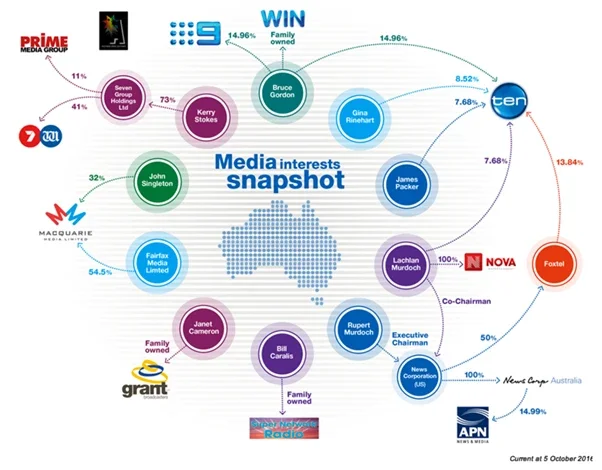
There is a significant impact that media ownership concentration has on news production as diversity of news as well as on public sphere practices due to the simplified range of voices present within the public. In Australia specifically, Lidberg argues that media ownership concentration is extremely high with only ‘a few corporations dominate news production’ (Lidberg, 2019). This limited ownership has an adverse effect on public sphere practices as audiences have a limited number of credible sources.
Public spheres play a major role in democratic countries as they allow people to become informed about important current issues, engage in discussion with their peers, and develop their own opinions about these topics. The ideas of the public sphere also imply that citizens can trust their news sources to receive information about various occurrences. Within the media organisation sphere, a limited number of news outlets are able to control what is talked about within the public due to their authority in generating news. (Cunningham 2014)
The ideas behind news generation support my point that news organisations don’t simply cover topics they help construct it through processes of selection and rejection of various ideas and arguments. Language and grammar can be used to place priority on specific topics or shape how the public should think about a current issue. (Cunningham 2014) To demonstrate this point, if you look at the way multiple news outlets cover the same political topic you will see that they are framed differently. News organisations have control over what the public is thinking about and how they should think about those topics.
New media platforms allow citizens to become informed about current events and political topics through many different outlets. This allows for news to come from a variety of sources and voices, giving the audience conflicting opinions and information.(Cunningham 2014) New media does not allow for citizens to avoid hyper-concentration because although there are many different platforms and articles for citizens to view, many of them fall into the same algorithm that caters to your interests and ignores the rest. As a result, you are still only being exposed to one type of voice and perspective although it may be disguised.
Funding cuts to many news sources forced journalists to create clickbait media to gain profit and readers. As a result of this, journalists are not able to focus as much time and effort on generating quality and credible news. There is still an impact on public sphere practices as readers are not able to be informed about certain topics due to a lack of news coverage. When thinking about how audiences receive and interact with news you could tie this to the Audience Theory as individuals have the power to seek out other news outlets. (Hall 1997)
In conclusion, Lidberg’s study allows people to further understand how media structure can play a role in real world politics and society. News media concentration has adverse effects on democracy, public sphere practices and creates a limited number of voices heard.
Reference list
Gauntlett, D 2007, ‘Ten things wrong with the “effects model”’, viewed online.
Chap for Arnold audiences reader 1997
Turnbull, S 2014, ‘Imagining the audience’, in S Cunningham & S Turnbull (eds), The Media and Communications in Australia, 4th edn, Allen & Unwin, Sydney, pp. 59–72.
The Media and Communications in Australia | Stuart Cunningham, Sue Tur
Fiske, John and Jenkins, Henry (2010) Introduction to Communication Studies: 3rd Edition. Routledge: London. In particular pp. 80-86 (semiotics and myths) and pp. 157-169 (Ideology).
Lidberg, J 2019, ‘The distortion of the Australian Public Sphere: Media ownership concentration in Australia’, AQ: Australian Quarterly, vol. 90, no. 1, pp. 12–20.
Hall, S 1997, ‘The work of representation’, in S Hall (ed.), Representation: Cultural Representations and Signifying Practices, Sage, London, pp. 13–51.
Cunningham, S 2014, ‘Policy and regulation’, in S Cunningham & S Turnbull (eds), The Media and Communications in Australia, 4th edn, Allen & Unwin, Sydney, pp. 85–90.
Policy and Regulation | 7 | v4 | The Media and Communications in Austr
Chandler, D 2011 , Semiotics for beginners
Create Your Own Website With Webador